

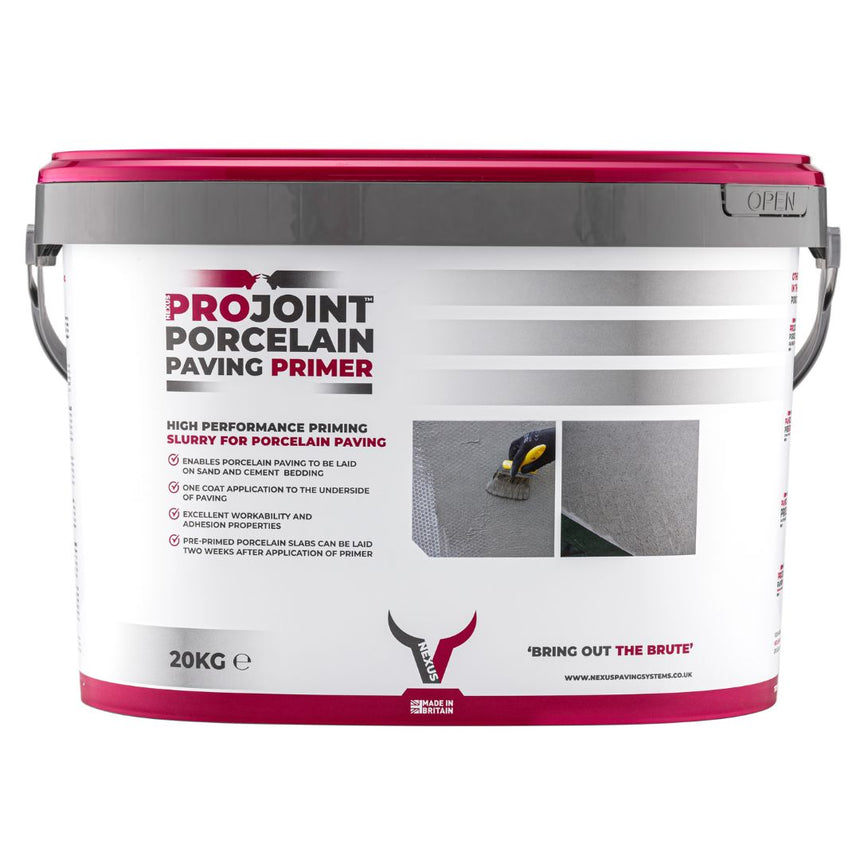
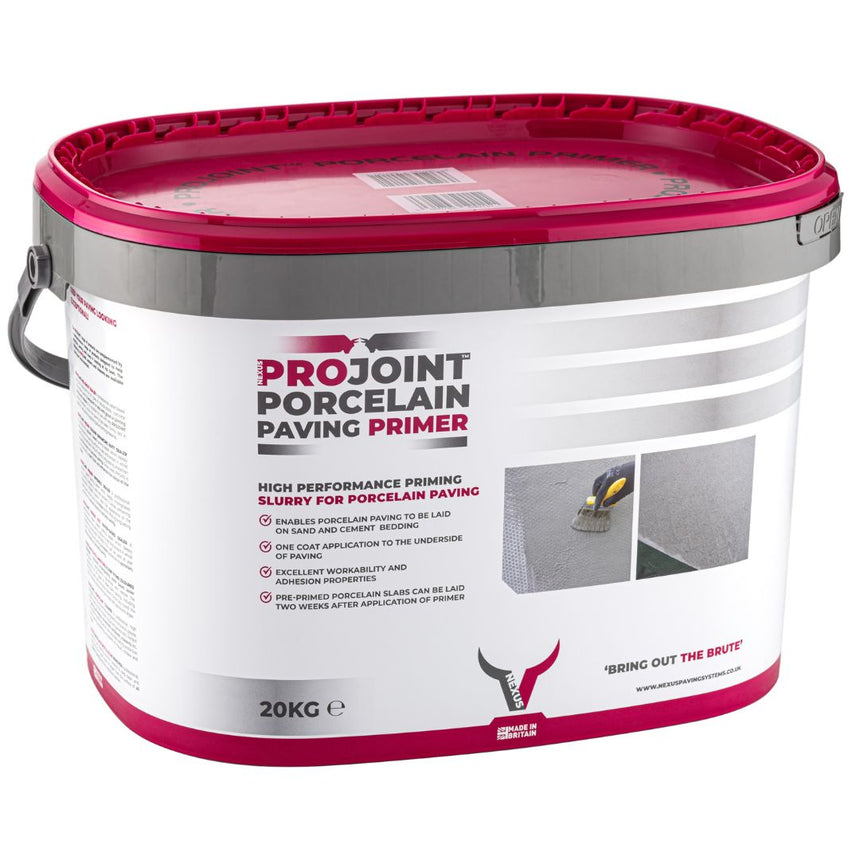
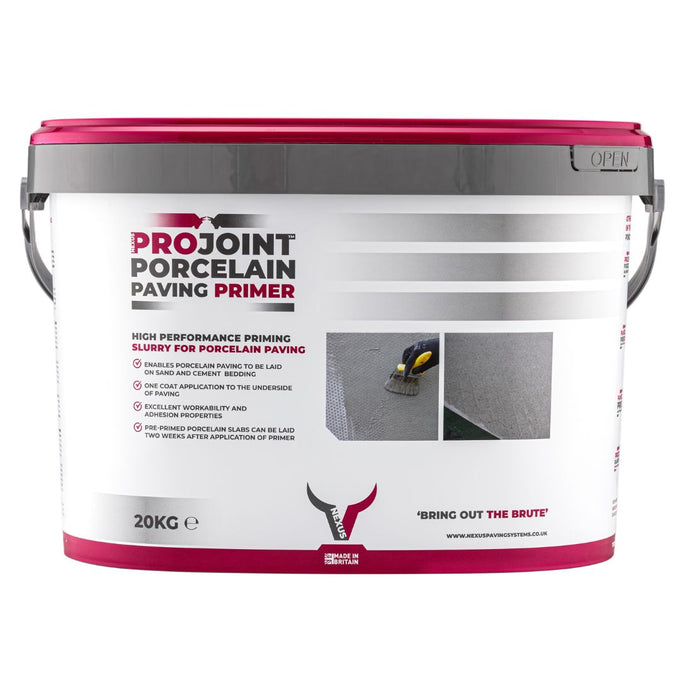
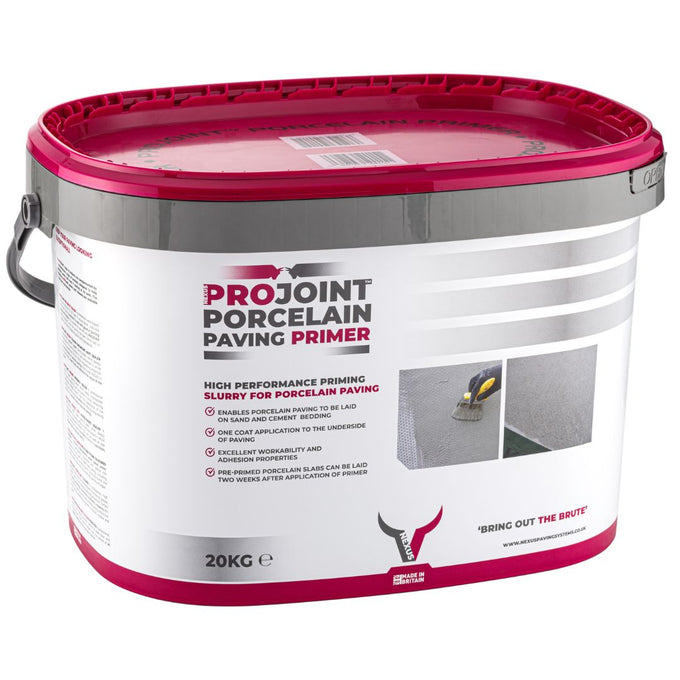
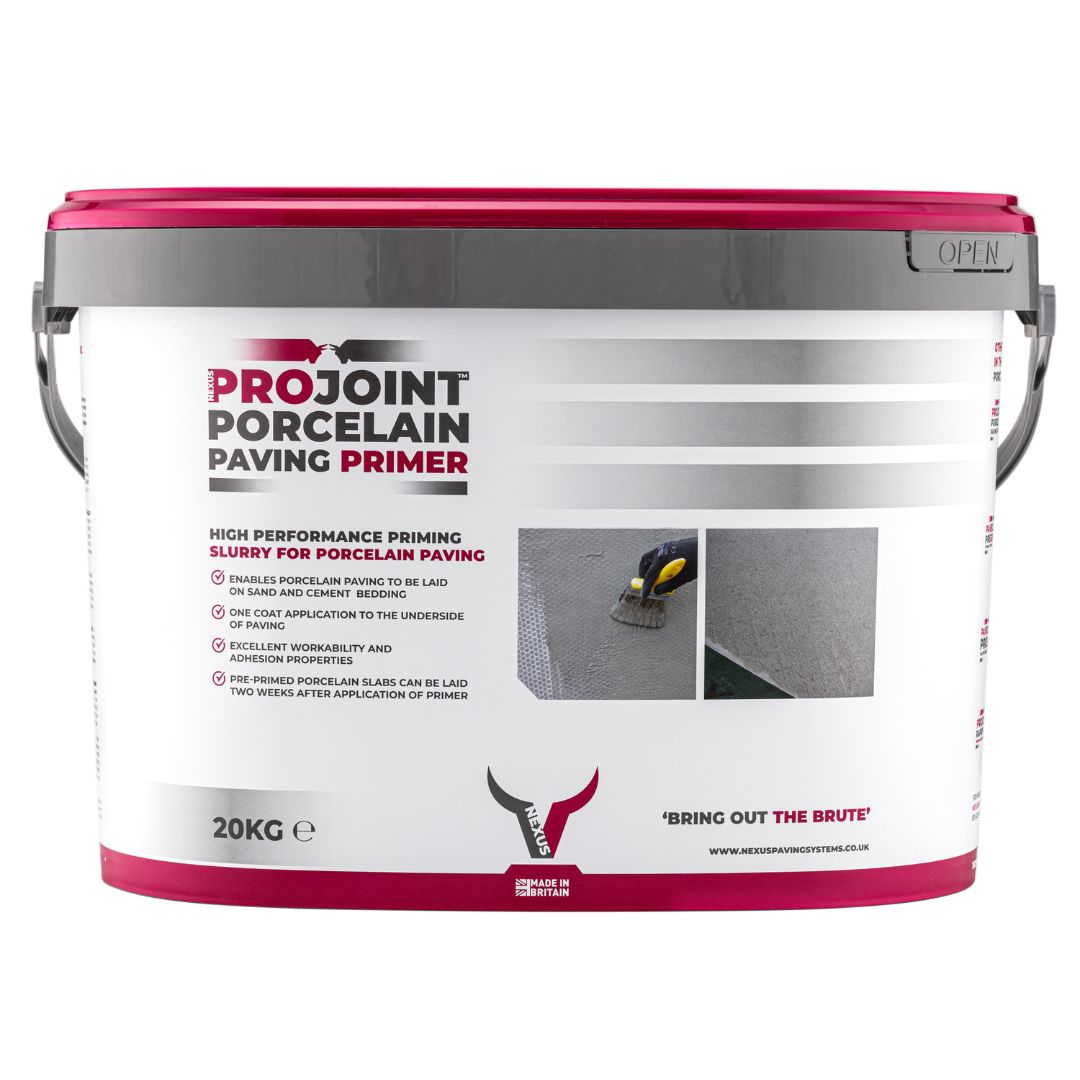
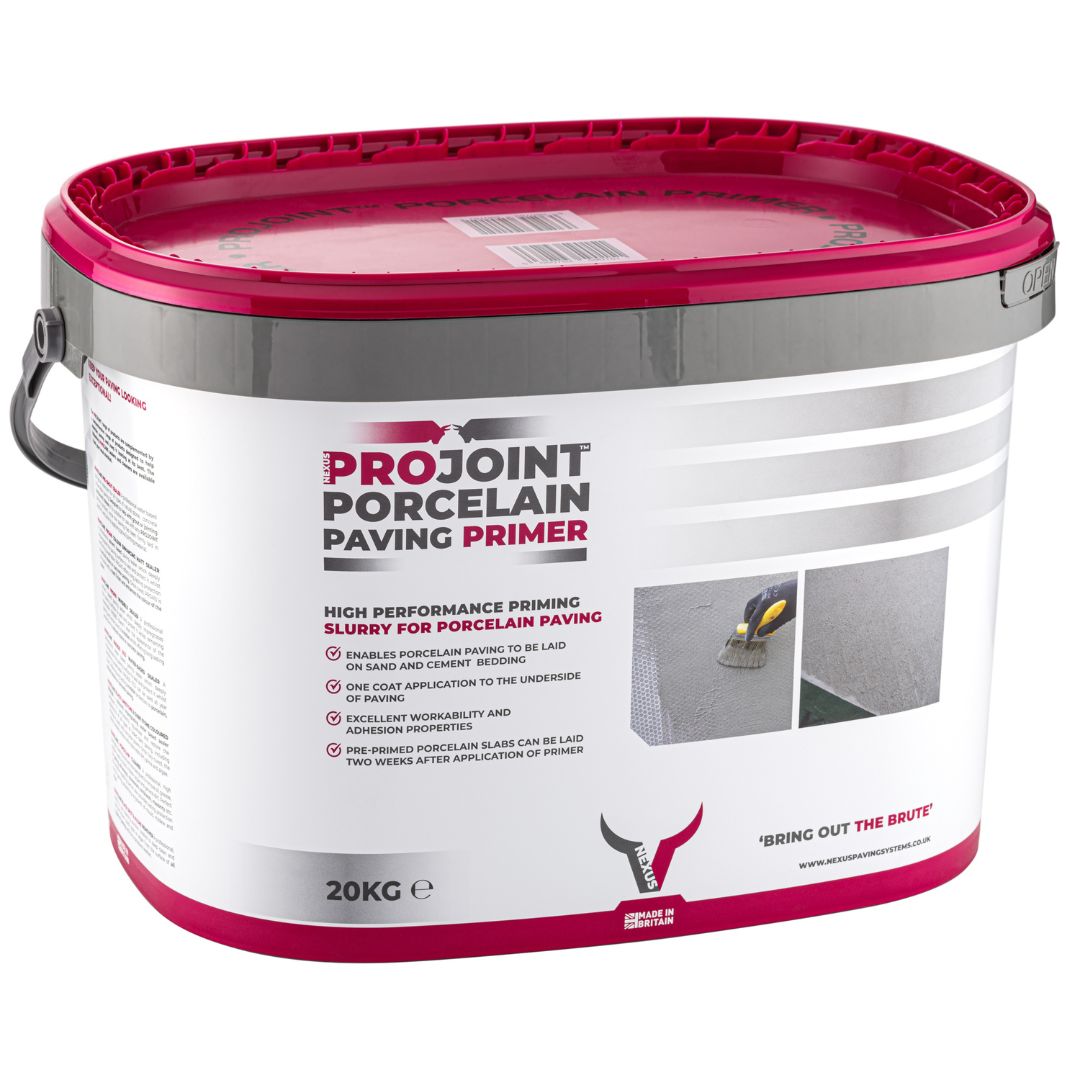
ProJoint Porcelain Primer | High-Performance Priming Slurry for Porcelain Paving
About the product
A high-performance priming slurry for porcelain paving
ProJoint Porcelain Primer is an ultra-high polymer and fibre modified flexible priming slurry for porcelain paving, natural stone, concrete and ceramic tiles. Applied in a single coat to the underside of the slab, it promotes adhesion and enables porcelain to be laid on a sand and cement bedding mortar — no specialist adhesive bed required. Simply mix with water and apply with a brush or roller. Dries in 10–15 minutes; primed slabs can be laid any time up to 2 weeks after priming. Suitable for internal and external use. Supplied as a 20kg tub with 2 x 10kg bags and a lidded mixing tub.
For permeable beds, use with ProJoint RapidFlow. For non-permeable beds, use with ProJoint TileJam. Before grouting, protect your paving with ProJoint Pre-Grout Sealer.
Got a question about ProJoint Porcelain Primer? Download the full technical datasheet or get in touch — we’re always happy to help. 😊
ProJoint Porcelain Primer | High-Performance Priming Slurry for Porcelain Paving


For Highlands, Guernsey, Jersey, Isle of Man, and Isle of Wight – call 0330 122 1025.
For Highlands, Guernsey, Jersey, Isle of Man, and Isle of Wight – call 0330 122 1025.
About the product
A high-performance priming slurry for porcelain paving
ProJoint Porcelain Primer is an ultra-high polymer and fibre modified flexible priming slurry for porcelain paving, natural stone, concrete and ceramic tiles. Applied in a single coat to the underside of the slab, it promotes adhesion and enables porcelain to be laid on a sand and cement bedding mortar — no specialist adhesive bed required. Simply mix with water and apply with a brush or roller. Dries in 10–15 minutes; primed slabs can be laid any time up to 2 weeks after priming. Suitable for internal and external use. Supplied as a 20kg tub with 2 x 10kg bags and a lidded mixing tub.
For permeable beds, use with ProJoint RapidFlow. For non-permeable beds, use with ProJoint TileJam. Before grouting, protect your paving with ProJoint Pre-Grout Sealer.
Got a question about ProJoint Porcelain Primer? Download the full technical datasheet or get in touch — we’re always happy to help. 😊
ProJoint Porcelain Primer | High-Performance Priming Slurry for Porcelain Paving
ProJoint Porcelain Primer is one of the best porcelain paving primers on the market — an excellent example of a bonding primer that genuinely solves one of the most common problems in porcelain paving installation. Porcelain’s near-zero porosity means standard bedding mortars struggle to grip the back of the slab — this priming slurry changes that. Applied as a single coat to the underside of each slab, it creates a bond bridge that allows porcelain to be laid confidently on a sand and cement mortar bed. It’s a product our customers consistently come back to tell us they’re delighted with: simple to mix, fast to dry, and it gives you up to 2 weeks between priming and laying.
High-performance slurry primer for porcelain and natural stone pavers. Single coat to the back of the slab. Dries in 10–15 minutes. Lay slabs any time up to 2 weeks after priming. Walk-on in 12 hours. Full strength at 28 days. Coverage approximately 27.5m² per 20kg tub. Supplied as a 20kg tub with 2 x 10kg bags and a lidded mixing tub.
We’re a small, family-run business — I’m Cleo, the owner, with over 25 years in the construction industry working with businesses including Tarmac and Instarmac. I work alongside a team of incredibly knowledgeable and caring individuals, and between us we’ve seen a lot of porcelain laying jobs go wrong because primer was skipped or the wrong product was used. A good paving primer is not an optional extra — it’s the step that determines whether your porcelain stays down.
Whether you’re a contractor laying hundreds of square metres or a DIYer doing a garden patio, this is the primer for porcelain paving we’d confidently reach for every time. For permeable beds, pair with ProJoint RapidFlow. For non-permeable beds, pair with ProJoint TileJam. And before grouting, protect your surface with ProJoint Pre-Grout Sealer. Call us if you’re unsure what you need — we’re always happy to help.
Why Do You Need Primer for Porcelain Paving?
Porcelain paving is one of the most popular choices for patios and outdoor spaces — but its low porosity creates a genuine installation challenge. Unlike natural stone, porcelain absorbs almost no water, which means standard sand and cement bedding mortar has very little to grip onto. Without a suitable bonding primer for porcelain paving, slabs can lift, rock or delaminate — sometimes within months of laying.
It’s also worth knowing that porcelain on the market today is not what it was even ten years ago. Slabs are being manufactured thinner than they used to be, and a significant volume of cheaper imports are coming in with inconsistent porosity — some more porous than they should be, others with poorly prepared backs that are difficult to bond to. We see the consequences of this regularly: efflorescence appearing through joints, staining that’s absorbed into the slab face, de-bonding, cracking, and premature failure of patios and paved areas that were expensive to install. A quality porcelain paving primer protects against all of these risks — it seals the back of the slab, promotes adhesion, and gives the bedding mortar something solid to hold onto regardless of the slab’s origin or quality.
A porcelain slurry primer works by coating the back of the slab with a high-polymer modified slurry that acts as a bond bridge between the paving and the bedding mortar. It dramatically increases adhesion, reduces the risk of failure, and enables porcelain to be laid on a conventional sand and cement bed rather than a specialist adhesive — saving time and cost.
Can you lay porcelain paving without primer? Technically yes — but we’d strongly advise against it. Unprimed porcelain slabs are significantly more likely to fail, particularly in exposed or trafficked areas. With the variable quality of imported porcelain now available, primer is more important than ever. It’s cheap insurance against a very expensive problem.
What is a Slurry Primer?
A slurry primer — sometimes called a paving bond bridge or bonding primer for porcelain paving — is a polymer-modified powder that is mixed with water to form a thick, paint-like slurry. It is brushed or rolled onto the back (underside) of each paving slab before laying. Once dry, it creates a textured, high-adhesion surface that bonds tightly to the bedding mortar beneath.
ProJoint Porcelain Primer is an ultra-high polymer and fibre modified slurry primer — a step above basic bonding primers in terms of adhesion strength and flexibility, making it suitable not just for porcelain but also for other low-absorption substrates including natural stone, ceramic tiles, concrete slabs and setts.
What is the difference between slurry primer and bonding primer? The terms are often used interchangeably. Slurry primer refers specifically to a powder-and-water mix applied as a wet coat. Bonding primer is a broader term that includes both slurry-type and liquid PVA-type primers. For porcelain paving, a slurry primer is generally preferred over PVA as it provides superior adhesion on non-porous surfaces and is specifically formulated for outdoor use.
Can you use PVA instead of paving primer? We do not recommend it for porcelain paving outdoors. PVA is a rubber-based product and, while it may appear to work initially, it becomes brittle in cold weather and is prone to cracking and failure during the colder months. This leads to loss of adhesion and slab movement — particularly problematic in the UK climate. A dedicated porcelain slurry primer such as ProJoint Porcelain Primer is the correct choice for reliable, long-term performance.
Key Benefits
- Creates a strong bond bridge on low-porosity surfaces — ultra-high polymer and fibre modified formula grips where standard mortars struggle
- Enables porcelain to be laid on sand and cement bedding — no specialist adhesive bed required
- Protects against staining, efflorescence and de-bonding — particularly important with thinner modern slabs and variable-quality imports
- Single coat to the back of the slab — fast and easy with a masonry brush or roller
- Dries in 10–15 minutes — depending on temperature and humidity
- Prime up to 2 weeks before laying — store primed slabs undercover with primed side protected
- Excellent workability and adhesion properties
- Can be applied in low temperatures — suitable between 3°C and 25°C
- Suitable for internal and external use
- Also suitable for natural stone, ceramic tiles, concrete slabs and setts
- Walk-on time 12 hours in dry ambient conditions; full strength at 28 days
- Supplied as a 20kg tub (2 x 10kg bags) with lidded tub as mixing vessel
Technical Information
| System | High-performance slurry primer for porcelain and natural stone pavers |
| Suitable for | Porcelain, natural stone, concrete, ceramic tiles, paving slabs and setts — internal and external |
| Sub-base requirement | Full solid bed — laid on wet sand and cement mortar bed |
| Application method | Single coat to the underside of the slab — masonry brush or roller |
| Mix ratio | 2.8 litres of cold clean water per 10kg bag |
| Pot life | Approximately 60 minutes at 20°C |
| Dry time | 10–15 minutes (temperature and humidity dependent) |
| Laying window | Immediately after drying, up to 2 weeks after application (store undercover) |
| Walk-on time | 12 hours in dry ambient conditions |
| Full strength | 28 days |
| Coverage | Approximately 27.5m² per 20kg tub (application method and porosity dependent) |
| Application temperature | 3°C to 25°C — do not use if frost forecast within 24 hours |
| Storage | Cool, dry, frost-free environment between 5°C and 30°C |
| Pack size | 20kg tubs (2 x 10kg bags) delivered on shrink-wrapped packaging |
| Pallet quantity | 100 units per pallet |
| Shelf life | 12 months from date of manufacture |
Download the full technical datasheet (PDF)
Preparation
The underside of the paving should be clean, dry and free of any material which may impair adhesion — do not apply to shiny or contaminated surfaces. Do not use in wet weather and do not use if frost is forecast within 24 hours of application. Suitable for use in temperatures between 3°C and 25°C.
How to Apply Primer to Porcelain Paving — Mixing & Application Instructions
- Remove the bags from the tub. Add 2.8 litres of cold clean water to the tub (which acts as the mixing vessel).
- Add the powder slowly and mix using a drill and paddle or plasterers’ whisk.
- Mix for 2 minutes.
- Leave to stand for 2 minutes — this is important as it allows the polymer additives to dissolve and activate.
- Re-mix for a further 2 minutes until a smooth, even consistency is achieved. Pot life is approximately 60 minutes at 20°C. Only mix what you need — mix less than a full bag for smaller areas.
- Wearing appropriate PPE, apply a thorough and even coat of the primer as a slurry to the underside of the paving using a masonry brush or roller. Yes — primer goes on the back of the porcelain slab, not the top.
- Allow the primer to dry completely — typically 10 to 15 minutes depending on conditions. Primed slabs can be stored undercover for up to 2 weeks before laying — keep the primed side protected from weathering and dirt.
- Lay paving on a wet sand and cement mortar bed.
- Wash all tools with water immediately after use. Do not empty waste material into drainage systems.
Common Mistakes to Avoid
- Skipping primer altogether — the most common cause of porcelain paving failure. Always prime, especially with thinner modern slabs or cheaper imported porcelain.
- Applying primer to dirty or dusty slabs — contamination prevents adhesion. Clean the back of each slab before priming.
- Laying before the primer is fully dry — wet primer will not bond correctly. Wait the full 10–15 minutes.
- Mixing a full bag when only a small area is needed — only mix what you need; pot life is 60 minutes.
- Storing primed slabs outdoors without protection — keep the primed face covered and dry until laying.
- Using PVA as a substitute — PVA is rubber-based and becomes brittle in cold weather, leading to cracking and adhesion failure. Use a dedicated porcelain slurry primer.
- Not sealing the surface before grouting — apply ProJoint Pre-Grout Sealer to the top face of the paving before grouting to prevent grout staining.
Frequently Asked Questions
I’m Cleo, owner of The Paving Experts, with over 25 years in the construction industry working with businesses including Tarmac and Instarmac. I work alongside a small team of incredibly knowledgeable and caring individuals who share the same passion for getting it right. The FAQ answers below come from the questions we’re asked every single day.
Do you need primer for porcelain paving?
Yes — and increasingly so. Modern porcelain is being manufactured thinner than it used to be, and a lot of the cheaper imports coming into the UK market have inconsistent porosity and poorly prepared backs. Without a primer, you risk staining, efflorescence, de-bonding, cracking and premature failure of your patio or paved area. Primer is cheap, quick to apply, and far less expensive than relaying failed paving.
Why do you need primer when laying porcelain paving?
Because porcelain doesn’t absorb water, the bedding mortar can’t penetrate the surface of the slab to form a mechanical bond. Primer fills that gap — it creates a textured, polymer-modified surface on the back of the slab that the mortar can key into. Without it, you’re relying on surface contact alone, which is rarely enough for long-term performance, particularly with the variable quality of porcelain available today.
What is slurry primer?
A slurry primer is a polymer-modified powder mixed with water to form a thick, brush-on coating. Applied to the back of paving slabs before laying, it acts as a bonding primer — creating a bond bridge between the slab and the bedding mortar. ProJoint Porcelain Primer is an ultra-high polymer and fibre modified slurry primer specifically developed for porcelain and other low-porosity paving.
What is the best primer for porcelain paving?
We consider ProJoint Porcelain Primer one of the best primers for porcelain paving on the market. Its ultra-high polymer and fibre modified formula provides superior adhesion on low-porosity surfaces, dries in 10–15 minutes, and gives you a 2-week window between priming and laying — which is invaluable on larger projects.
Can you lay porcelain paving without primer?
Technically yes, but we strongly advise against it. With thinner modern slabs and variable-quality imports increasingly common, the risk of failure without primer is higher than ever. The cost of primer is negligible compared to the cost of lifting and relaying a failed patio.
Does primer go on the back of the porcelain slab?
Yes — always apply paving primer to the underside (back) of the slab, not the top. The primer is what bonds the slab to the bedding mortar beneath it. Apply a thorough, even coat with a masonry brush or roller and allow to dry fully before laying.
How much porcelain paving primer do I need?
Approximately 27.5m² per 20kg tub, depending on application method and paving porosity. Not sure how much you need? Call us and we’ll calculate it for you — 0330 122 1025.
How long does paving primer take to dry?
Typically 10 to 15 minutes, depending on temperature and humidity. Always check the primer is fully dry before laying. In cold or damp conditions, allow a little longer.
Can paving primer be used on natural stone?
Yes — although ProJoint Porcelain Primer is optimised for porcelain, it can also be used on natural stone, concrete, ceramic tiles, paving slabs and setts for both internal and external applications.
What is the difference between slurry primer and bonding primer?
The terms are often used interchangeably. Slurry primer refers to a powder-and-water mix applied as a wet coat to the back of the slab. Bonding primer is a broader term covering both slurry-type and liquid (PVA-type) primers. For porcelain paving outdoors, a slurry primer is the preferred choice — it outperforms PVA-based products in adhesion strength and durability.
Can you use PVA instead of paving primer?
We do not recommend PVA for porcelain paving outdoors. PVA is a rubber-based product and, while it may appear to work initially, it becomes brittle in cold weather and is prone to cracking and failure during the colder months. This leads to loss of adhesion and slab movement — particularly problematic in the UK climate. Always use a dedicated porcelain slurry primer such as ProJoint Porcelain Primer for reliable, long-term performance.
Once the primer is applied and dried, how long do I have to lay the slabs?
You can lay the slabs immediately after the primer has dried, or any time up to 2 weeks after application. Just make sure the primed side is stored undercover and protected from weathering and dirt.
Do I need to mix a full bag at once?
No — only mix what you need. If you’re working on a small area, mix less to avoid waste. The pot life of the mixed primer is approximately 60 minutes at 20°C.
Which jointing compound do you recommend alongside this primer?
It depends on your sub-base. For permeable beds (free-draining sand and cement), we recommend ProJoint RapidFlow. For non-permeable beds (solid concrete or impermeable base), we recommend ProJoint TileJam. Not sure which applies to you? Give us a call — 0330 122 1025.
Should I seal my paving before grouting?
Yes — we strongly recommend applying ProJoint Pre-Grout Stone & Porcelain Paving Sealer to the surface of the paving before grouting. This temporary protective sealer guards the paving face against grout staining, making clean-up much easier and giving a cleaner, more professional finish.
Ready to Order?
Add ProJoint Porcelain Primer to your basket above, or get in touch if you’d like help working out how much you need. Call us on 0330 122 1025 — we’re always happy to help.
- Brand: Nexus
- Product Type: Paving Primer
- SKU: TPE-PP227BE
- Weight: 20.0 kg / 44.09 lb
Delivery & Returns Info
Our delivery charges are calculated based on the size and weight of your order. When you add items to your basket, the delivery charges are displayed. Small orders are distributed via courier; larger orders via Pallet Network. Collection is available from our Tamworth depot by request (contact us first to arrange on 0330 122 1025).
Please note, there is a slight surcharge for areas that are outside of our locality, charges calculated at checkout.
| Weight and size | Next Working Day* Order before 1PM (excl. VAT) |
Standard 3-5 Working Day (excl. VAT) |
|---|---|---|
| 0-13KG (1 small bag/tub) |
£14.00 | £9.00 |
| 13.01-25KG (1 large bag/tub) |
£16.00 | £10.00 |
| 25.01-50KG (2 bags/tubs) |
£26.00 | £19.00 |
| 50.01-75KG (3 bags/tubs) |
£36.00 | £28.00 |
| 75.01-100KG (4-5 bags/tubs) |
£46.00 | £37.00 |
| 100.01-249KG (6-9 bags/tubs) |
£60.00 | £45.00 |
| 249.01-750KG (10 bags plus) |
£68.00 | £48.00 |
| 750.01KG plus (30 bags plus) |
£75.00 | £55.00 |
| Full Pallets (56 bags/52 tubs) |
£88.00 | Free of charge |
| Next Working Day delivery (Premium 1-2 Working Day Service) | +avg. £5-10 Extra. Click here for prices |
|---|---|
| Scotland Delivery Service (Deliveries into some parts of Scotland can take 8-10 working days) | Click here for prices |
| Local Delivery & Click & Collect: | Email: orders@thepavingexperts.co.uk |
Delivery Information
- Prices apply to mainland England and Wales. Scottish delivery slight surcharge.
- Orders are packed and dispatched Monday–Friday (excluding weekends & public holidays).
Next Working Day Delivery
- Order before 1PM → same-day dispatch.
- Order after 1PM or on weekends/bank holidays → next working day dispatch.
- You'll receive tracking updates via email/SMS if you provide your details.
Delivery Examples
- Mon before 1PM → Packed Mon, delivered Tue.
- Mon after 1PM → Packed Tues delivered Wed.
- Fri before 1PM → Packed Fri, delivered Mon.
- Fri after 1PM/weekend → Packed Mon, delivered Tues (or Wed after a bank holiday).
- Standard Service: 3–5 working days.
Notes
- Occasional delays due to manufacturing, supply, or courier issues may happen, but we'll keep you informed.
Returns, cancel up to 14 days from date of delivery. Product to be returned in the same condition & packaging. No returns for cementitious & perishable products. You are responsible for the cost of returning goods to The Paving Experts, 20% admin restock fee applies. Need further info, click here.
For further detailed delivery information click here →
For any advice; technical, product, stock or quantity needed, call our team on 0330 122 1025.
Please see our FAQs for more information.


ProJoint Porcelain Primer | High-Performance Priming Slurry for Porcelain Paving
ProJoint Porcelain Primer is one of the best porcelain paving primers on the market — an excellent example of a bonding primer that genuinely solves one of the most common problems in porcelain paving installation. Porcelain’s near-zero porosity means standard bedding mortars struggle to grip the back of the slab — this priming slurry changes that. Applied as a single coat to the underside of each slab, it creates a bond bridge that allows porcelain to be laid confidently on a sand and cement mortar bed. It’s a product our customers consistently come back to tell us they’re delighted with: simple to mix, fast to dry, and it gives you up to 2 weeks between priming and laying.
High-performance slurry primer for porcelain and natural stone pavers. Single coat to the back of the slab. Dries in 10–15 minutes. Lay slabs any time up to 2 weeks after priming. Walk-on in 12 hours. Full strength at 28 days. Coverage approximately 27.5m² per 20kg tub. Supplied as a 20kg tub with 2 x 10kg bags and a lidded mixing tub.
We’re a small, family-run business — I’m Cleo, the owner, with over 25 years in the construction industry working with businesses including Tarmac and Instarmac. I work alongside a team of incredibly knowledgeable and caring individuals, and between us we’ve seen a lot of porcelain laying jobs go wrong because primer was skipped or the wrong product was used. A good paving primer is not an optional extra — it’s the step that determines whether your porcelain stays down.
Whether you’re a contractor laying hundreds of square metres or a DIYer doing a garden patio, this is the primer for porcelain paving we’d confidently reach for every time. For permeable beds, pair with ProJoint RapidFlow. For non-permeable beds, pair with ProJoint TileJam. And before grouting, protect your surface with ProJoint Pre-Grout Sealer. Call us if you’re unsure what you need — we’re always happy to help.
Why Do You Need Primer for Porcelain Paving?
Porcelain paving is one of the most popular choices for patios and outdoor spaces — but its low porosity creates a genuine installation challenge. Unlike natural stone, porcelain absorbs almost no water, which means standard sand and cement bedding mortar has very little to grip onto. Without a suitable bonding primer for porcelain paving, slabs can lift, rock or delaminate — sometimes within months of laying.
It’s also worth knowing that porcelain on the market today is not what it was even ten years ago. Slabs are being manufactured thinner than they used to be, and a significant volume of cheaper imports are coming in with inconsistent porosity — some more porous than they should be, others with poorly prepared backs that are difficult to bond to. We see the consequences of this regularly: efflorescence appearing through joints, staining that’s absorbed into the slab face, de-bonding, cracking, and premature failure of patios and paved areas that were expensive to install. A quality porcelain paving primer protects against all of these risks — it seals the back of the slab, promotes adhesion, and gives the bedding mortar something solid to hold onto regardless of the slab’s origin or quality.
A porcelain slurry primer works by coating the back of the slab with a high-polymer modified slurry that acts as a bond bridge between the paving and the bedding mortar. It dramatically increases adhesion, reduces the risk of failure, and enables porcelain to be laid on a conventional sand and cement bed rather than a specialist adhesive — saving time and cost.
Can you lay porcelain paving without primer? Technically yes — but we’d strongly advise against it. Unprimed porcelain slabs are significantly more likely to fail, particularly in exposed or trafficked areas. With the variable quality of imported porcelain now available, primer is more important than ever. It’s cheap insurance against a very expensive problem.
What is a Slurry Primer?
A slurry primer — sometimes called a paving bond bridge or bonding primer for porcelain paving — is a polymer-modified powder that is mixed with water to form a thick, paint-like slurry. It is brushed or rolled onto the back (underside) of each paving slab before laying. Once dry, it creates a textured, high-adhesion surface that bonds tightly to the bedding mortar beneath.
ProJoint Porcelain Primer is an ultra-high polymer and fibre modified slurry primer — a step above basic bonding primers in terms of adhesion strength and flexibility, making it suitable not just for porcelain but also for other low-absorption substrates including natural stone, ceramic tiles, concrete slabs and setts.
What is the difference between slurry primer and bonding primer? The terms are often used interchangeably. Slurry primer refers specifically to a powder-and-water mix applied as a wet coat. Bonding primer is a broader term that includes both slurry-type and liquid PVA-type primers. For porcelain paving, a slurry primer is generally preferred over PVA as it provides superior adhesion on non-porous surfaces and is specifically formulated for outdoor use.
Can you use PVA instead of paving primer? We do not recommend it for porcelain paving outdoors. PVA is a rubber-based product and, while it may appear to work initially, it becomes brittle in cold weather and is prone to cracking and failure during the colder months. This leads to loss of adhesion and slab movement — particularly problematic in the UK climate. A dedicated porcelain slurry primer such as ProJoint Porcelain Primer is the correct choice for reliable, long-term performance.
Key Benefits
- Creates a strong bond bridge on low-porosity surfaces — ultra-high polymer and fibre modified formula grips where standard mortars struggle
- Enables porcelain to be laid on sand and cement bedding — no specialist adhesive bed required
- Protects against staining, efflorescence and de-bonding — particularly important with thinner modern slabs and variable-quality imports
- Single coat to the back of the slab — fast and easy with a masonry brush or roller
- Dries in 10–15 minutes — depending on temperature and humidity
- Prime up to 2 weeks before laying — store primed slabs undercover with primed side protected
- Excellent workability and adhesion properties
- Can be applied in low temperatures — suitable between 3°C and 25°C
- Suitable for internal and external use
- Also suitable for natural stone, ceramic tiles, concrete slabs and setts
- Walk-on time 12 hours in dry ambient conditions; full strength at 28 days
- Supplied as a 20kg tub (2 x 10kg bags) with lidded tub as mixing vessel
Technical Information
| System | High-performance slurry primer for porcelain and natural stone pavers |
| Suitable for | Porcelain, natural stone, concrete, ceramic tiles, paving slabs and setts — internal and external |
| Sub-base requirement | Full solid bed — laid on wet sand and cement mortar bed |
| Application method | Single coat to the underside of the slab — masonry brush or roller |
| Mix ratio | 2.8 litres of cold clean water per 10kg bag |
| Pot life | Approximately 60 minutes at 20°C |
| Dry time | 10–15 minutes (temperature and humidity dependent) |
| Laying window | Immediately after drying, up to 2 weeks after application (store undercover) |
| Walk-on time | 12 hours in dry ambient conditions |
| Full strength | 28 days |
| Coverage | Approximately 27.5m² per 20kg tub (application method and porosity dependent) |
| Application temperature | 3°C to 25°C — do not use if frost forecast within 24 hours |
| Storage | Cool, dry, frost-free environment between 5°C and 30°C |
| Pack size | 20kg tubs (2 x 10kg bags) delivered on shrink-wrapped packaging |
| Pallet quantity | 100 units per pallet |
| Shelf life | 12 months from date of manufacture |
Download the full technical datasheet (PDF)
Preparation
The underside of the paving should be clean, dry and free of any material which may impair adhesion — do not apply to shiny or contaminated surfaces. Do not use in wet weather and do not use if frost is forecast within 24 hours of application. Suitable for use in temperatures between 3°C and 25°C.
How to Apply Primer to Porcelain Paving — Mixing & Application Instructions
- Remove the bags from the tub. Add 2.8 litres of cold clean water to the tub (which acts as the mixing vessel).
- Add the powder slowly and mix using a drill and paddle or plasterers’ whisk.
- Mix for 2 minutes.
- Leave to stand for 2 minutes — this is important as it allows the polymer additives to dissolve and activate.
- Re-mix for a further 2 minutes until a smooth, even consistency is achieved. Pot life is approximately 60 minutes at 20°C. Only mix what you need — mix less than a full bag for smaller areas.
- Wearing appropriate PPE, apply a thorough and even coat of the primer as a slurry to the underside of the paving using a masonry brush or roller. Yes — primer goes on the back of the porcelain slab, not the top.
- Allow the primer to dry completely — typically 10 to 15 minutes depending on conditions. Primed slabs can be stored undercover for up to 2 weeks before laying — keep the primed side protected from weathering and dirt.
- Lay paving on a wet sand and cement mortar bed.
- Wash all tools with water immediately after use. Do not empty waste material into drainage systems.
Common Mistakes to Avoid
- Skipping primer altogether — the most common cause of porcelain paving failure. Always prime, especially with thinner modern slabs or cheaper imported porcelain.
- Applying primer to dirty or dusty slabs — contamination prevents adhesion. Clean the back of each slab before priming.
- Laying before the primer is fully dry — wet primer will not bond correctly. Wait the full 10–15 minutes.
- Mixing a full bag when only a small area is needed — only mix what you need; pot life is 60 minutes.
- Storing primed slabs outdoors without protection — keep the primed face covered and dry until laying.
- Using PVA as a substitute — PVA is rubber-based and becomes brittle in cold weather, leading to cracking and adhesion failure. Use a dedicated porcelain slurry primer.
- Not sealing the surface before grouting — apply ProJoint Pre-Grout Sealer to the top face of the paving before grouting to prevent grout staining.
Frequently Asked Questions
I’m Cleo, owner of The Paving Experts, with over 25 years in the construction industry working with businesses including Tarmac and Instarmac. I work alongside a small team of incredibly knowledgeable and caring individuals who share the same passion for getting it right. The FAQ answers below come from the questions we’re asked every single day.
Do you need primer for porcelain paving?
Yes — and increasingly so. Modern porcelain is being manufactured thinner than it used to be, and a lot of the cheaper imports coming into the UK market have inconsistent porosity and poorly prepared backs. Without a primer, you risk staining, efflorescence, de-bonding, cracking and premature failure of your patio or paved area. Primer is cheap, quick to apply, and far less expensive than relaying failed paving.
Why do you need primer when laying porcelain paving?
Because porcelain doesn’t absorb water, the bedding mortar can’t penetrate the surface of the slab to form a mechanical bond. Primer fills that gap — it creates a textured, polymer-modified surface on the back of the slab that the mortar can key into. Without it, you’re relying on surface contact alone, which is rarely enough for long-term performance, particularly with the variable quality of porcelain available today.
What is slurry primer?
A slurry primer is a polymer-modified powder mixed with water to form a thick, brush-on coating. Applied to the back of paving slabs before laying, it acts as a bonding primer — creating a bond bridge between the slab and the bedding mortar. ProJoint Porcelain Primer is an ultra-high polymer and fibre modified slurry primer specifically developed for porcelain and other low-porosity paving.
What is the best primer for porcelain paving?
We consider ProJoint Porcelain Primer one of the best primers for porcelain paving on the market. Its ultra-high polymer and fibre modified formula provides superior adhesion on low-porosity surfaces, dries in 10–15 minutes, and gives you a 2-week window between priming and laying — which is invaluable on larger projects.
Can you lay porcelain paving without primer?
Technically yes, but we strongly advise against it. With thinner modern slabs and variable-quality imports increasingly common, the risk of failure without primer is higher than ever. The cost of primer is negligible compared to the cost of lifting and relaying a failed patio.
Does primer go on the back of the porcelain slab?
Yes — always apply paving primer to the underside (back) of the slab, not the top. The primer is what bonds the slab to the bedding mortar beneath it. Apply a thorough, even coat with a masonry brush or roller and allow to dry fully before laying.
How much porcelain paving primer do I need?
Approximately 27.5m² per 20kg tub, depending on application method and paving porosity. Not sure how much you need? Call us and we’ll calculate it for you — 0330 122 1025.
How long does paving primer take to dry?
Typically 10 to 15 minutes, depending on temperature and humidity. Always check the primer is fully dry before laying. In cold or damp conditions, allow a little longer.
Can paving primer be used on natural stone?
Yes — although ProJoint Porcelain Primer is optimised for porcelain, it can also be used on natural stone, concrete, ceramic tiles, paving slabs and setts for both internal and external applications.
What is the difference between slurry primer and bonding primer?
The terms are often used interchangeably. Slurry primer refers to a powder-and-water mix applied as a wet coat to the back of the slab. Bonding primer is a broader term covering both slurry-type and liquid (PVA-type) primers. For porcelain paving outdoors, a slurry primer is the preferred choice — it outperforms PVA-based products in adhesion strength and durability.
Can you use PVA instead of paving primer?
We do not recommend PVA for porcelain paving outdoors. PVA is a rubber-based product and, while it may appear to work initially, it becomes brittle in cold weather and is prone to cracking and failure during the colder months. This leads to loss of adhesion and slab movement — particularly problematic in the UK climate. Always use a dedicated porcelain slurry primer such as ProJoint Porcelain Primer for reliable, long-term performance.
Once the primer is applied and dried, how long do I have to lay the slabs?
You can lay the slabs immediately after the primer has dried, or any time up to 2 weeks after application. Just make sure the primed side is stored undercover and protected from weathering and dirt.
Do I need to mix a full bag at once?
No — only mix what you need. If you’re working on a small area, mix less to avoid waste. The pot life of the mixed primer is approximately 60 minutes at 20°C.
Which jointing compound do you recommend alongside this primer?
It depends on your sub-base. For permeable beds (free-draining sand and cement), we recommend ProJoint RapidFlow. For non-permeable beds (solid concrete or impermeable base), we recommend ProJoint TileJam. Not sure which applies to you? Give us a call — 0330 122 1025.
Should I seal my paving before grouting?
Yes — we strongly recommend applying ProJoint Pre-Grout Stone & Porcelain Paving Sealer to the surface of the paving before grouting. This temporary protective sealer guards the paving face against grout staining, making clean-up much easier and giving a cleaner, more professional finish.
Ready to Order?
Add ProJoint Porcelain Primer to your basket above, or get in touch if you’d like help working out how much you need. Call us on 0330 122 1025 — we’re always happy to help.
| System | High-performance slurry primer for porcelain and natural stone pavers |
| Suitable for | Porcelain, natural stone, concrete, ceramic tiles, paving slabs and setts — internal and external |
| Sub-base requirement | Full solid bed — laid on wet sand and cement mortar bed |
| Application method | Single coat to the underside of the slab — masonry brush or roller |
| Mix ratio | 2.8 litres of cold clean water per 10kg bag |
| Pot life | Approximately 60 minutes at 20°C |
| Dry time | 10–15 minutes (temperature and humidity dependent) |
| Laying window | Immediately after drying, up to 2 weeks after application (store undercover) |
| Walk-on time | 12 hours in dry ambient conditions |
| Full strength | 28 days |
| Coverage | Approximately 27.5m² per 20kg tub (application method and porosity dependent) |
| Application temperature | 3°C to 25°C — do not use if frost forecast within 24 hours |
| Storage | Cool, dry, frost-free environment between 5°C and 30°C |
| Pack size | 20kg tubs (2 x 10kg bags) delivered on shrink-wrapped packaging |
| Pallet quantity | 100 units per pallet |
| Shelf life | 12 months from date of manufacture |
Mixing Instructions
- Remove the bags from the tub. Add 2.8 litres of cold clean water to the tub (which acts as the mixing vessel).
- Add the powder slowly and mix using a drill and paddle or plasterers’ whisk.
- Mix for 2 minutes.
- Leave to stand for 2 minutes — this is important as it allows the polymer additives to dissolve and activate.
- Re-mix for a further 2 minutes until a smooth, even consistency is achieved.
Only mix what you need. Pot life is approximately 60 minutes at 20°C.
Application Instructions
- Wearing appropriate PPE, apply a thorough and even coat of the primer as a slurry to the underside of the paving using a masonry brush or roller.
- Allow the primer to dry completely — typically 10 to 15 minutes depending on conditions. Primed slabs can be stored undercover for up to 2 weeks before laying — keep the primed side protected from weathering and dirt.
- Lay paving on a wet sand and cement mortar bed.
- Wash all tools with water immediately after use. Do not empty waste material into drainage systems.
Delivery & Returns Info
Our delivery charges are calculated based on the size and weight of your order. When you add items to your basket, the delivery charges are displayed. Small orders are distributed via courier; larger orders via Pallet Network. Collection is available from our Tamworth depot by request (contact us first to arrange on 0330 122 1025).
Please note, there is a slight surcharge for areas that are outside of our locality, charges calculated at checkout.
| Weight and size | Next Working Day* Order before 1PM (excl. VAT) |
Standard 3-5 Working Day (excl. VAT) |
|---|---|---|
| 0-13KG (1 small bag/tub) |
£14.00 | £9.00 |
| 13.01-25KG (1 large bag/tub) |
£16.00 | £10.00 |
| 25.01-50KG (2 bags/tubs) |
£26.00 | £19.00 |
| 50.01-75KG (3 bags/tubs) |
£36.00 | £28.00 |
| 75.01-100KG (4-5 bags/tubs) |
£46.00 | £37.00 |
| 100.01-249KG (6-9 bags/tubs) |
£60.00 | £45.00 |
| 249.01-750KG (10 bags plus) |
£68.00 | £48.00 |
| 750.01KG plus (30 bags plus) |
£75.00 | £55.00 |
| Full Pallets (56 bags/52 tubs) |
£88.00 | Free of charge |
| Next Working Day delivery (Premium 1-2 Working Day Service) | +avg. £5-10 Extra. Click here for prices |
|---|---|
| Scotland Delivery Service (Deliveries into some parts of Scotland can take 8-10 working days) | Click here for prices |
| Local Delivery & Click & Collect: | Email: orders@thepavingexperts.co.uk |
Delivery Information
- Prices apply to mainland England and Wales. Scottish delivery slight surcharge.
- Orders are packed and dispatched Monday–Friday (excluding weekends & public holidays).
Next Working Day Delivery
- Order before 1PM → same-day dispatch.
- Order after 1PM or on weekends/bank holidays → next working day dispatch.
- You'll receive tracking updates via email/SMS if you provide your details.
Delivery Examples
- Mon before 1PM → Packed Mon, delivered Tue.
- Mon after 1PM → Packed Tues delivered Wed.
- Fri before 1PM → Packed Fri, delivered Mon.
- Fri after 1PM/weekend → Packed Mon, delivered Tues (or Wed after a bank holiday).
- Standard Service: 3–5 working days.
Notes
- Occasional delays due to manufacturing, supply, or courier issues may happen, but we'll keep you informed.
Returns, cancel up to 14 days from date of delivery. Product to be returned in the same condition & packaging. No returns for cementitious & perishable products. You are responsible for the cost of returning goods to The Paving Experts, 20% admin restock fee applies. Need further info, click here.
For further detailed delivery information click here →
ProJoint Porcelain Primer | High-Performance Priming Slurry for Porcelain Paving
ProJoint Porcelain Primer is one of the best porcelain paving primers on the market — an excellent example of a bonding primer that genuinely solves one of the most common problems in porcelain paving installation. Porcelain’s near-zero porosity means standard bedding mortars struggle to grip the back of the slab — this priming slurry changes that. Applied as a single coat to the underside of each slab, it creates a bond bridge that allows porcelain to be laid confidently on a sand and cement mortar bed. It’s a product our customers consistently come back to tell us they’re delighted with: simple to mix, fast to dry, and it gives you up to 2 weeks between priming and laying.
High-performance slurry primer for porcelain and natural stone pavers. Single coat to the back of the slab. Dries in 10–15 minutes. Lay slabs any time up to 2 weeks after priming. Walk-on in 12 hours. Full strength at 28 days. Coverage approximately 27.5m² per 20kg tub. Supplied as a 20kg tub with 2 x 10kg bags and a lidded mixing tub.
We’re a small, family-run business — I’m Cleo, the owner, with over 25 years in the construction industry working with businesses including Tarmac and Instarmac. I work alongside a team of incredibly knowledgeable and caring individuals, and between us we’ve seen a lot of porcelain laying jobs go wrong because primer was skipped or the wrong product was used. A good paving primer is not an optional extra — it’s the step that determines whether your porcelain stays down.
Whether you’re a contractor laying hundreds of square metres or a DIYer doing a garden patio, this is the primer for porcelain paving we’d confidently reach for every time. For permeable beds, pair with ProJoint RapidFlow. For non-permeable beds, pair with ProJoint TileJam. And before grouting, protect your surface with ProJoint Pre-Grout Sealer. Call us if you’re unsure what you need — we’re always happy to help.
Why Do You Need Primer for Porcelain Paving?
Porcelain paving is one of the most popular choices for patios and outdoor spaces — but its low porosity creates a genuine installation challenge. Unlike natural stone, porcelain absorbs almost no water, which means standard sand and cement bedding mortar has very little to grip onto. Without a suitable bonding primer for porcelain paving, slabs can lift, rock or delaminate — sometimes within months of laying.
It’s also worth knowing that porcelain on the market today is not what it was even ten years ago. Slabs are being manufactured thinner than they used to be, and a significant volume of cheaper imports are coming in with inconsistent porosity — some more porous than they should be, others with poorly prepared backs that are difficult to bond to. We see the consequences of this regularly: efflorescence appearing through joints, staining that’s absorbed into the slab face, de-bonding, cracking, and premature failure of patios and paved areas that were expensive to install. A quality porcelain paving primer protects against all of these risks — it seals the back of the slab, promotes adhesion, and gives the bedding mortar something solid to hold onto regardless of the slab’s origin or quality.
A porcelain slurry primer works by coating the back of the slab with a high-polymer modified slurry that acts as a bond bridge between the paving and the bedding mortar. It dramatically increases adhesion, reduces the risk of failure, and enables porcelain to be laid on a conventional sand and cement bed rather than a specialist adhesive — saving time and cost.
Can you lay porcelain paving without primer? Technically yes — but we’d strongly advise against it. Unprimed porcelain slabs are significantly more likely to fail, particularly in exposed or trafficked areas. With the variable quality of imported porcelain now available, primer is more important than ever. It’s cheap insurance against a very expensive problem.
What is a Slurry Primer?
A slurry primer — sometimes called a paving bond bridge or bonding primer for porcelain paving — is a polymer-modified powder that is mixed with water to form a thick, paint-like slurry. It is brushed or rolled onto the back (underside) of each paving slab before laying. Once dry, it creates a textured, high-adhesion surface that bonds tightly to the bedding mortar beneath.
ProJoint Porcelain Primer is an ultra-high polymer and fibre modified slurry primer — a step above basic bonding primers in terms of adhesion strength and flexibility, making it suitable not just for porcelain but also for other low-absorption substrates including natural stone, ceramic tiles, concrete slabs and setts.
What is the difference between slurry primer and bonding primer? The terms are often used interchangeably. Slurry primer refers specifically to a powder-and-water mix applied as a wet coat. Bonding primer is a broader term that includes both slurry-type and liquid PVA-type primers. For porcelain paving, a slurry primer is generally preferred over PVA as it provides superior adhesion on non-porous surfaces and is specifically formulated for outdoor use.
Can you use PVA instead of paving primer? We do not recommend it for porcelain paving outdoors. PVA is a rubber-based product and, while it may appear to work initially, it becomes brittle in cold weather and is prone to cracking and failure during the colder months. This leads to loss of adhesion and slab movement — particularly problematic in the UK climate. A dedicated porcelain slurry primer such as ProJoint Porcelain Primer is the correct choice for reliable, long-term performance.
Key Benefits
- Creates a strong bond bridge on low-porosity surfaces — ultra-high polymer and fibre modified formula grips where standard mortars struggle
- Enables porcelain to be laid on sand and cement bedding — no specialist adhesive bed required
- Protects against staining, efflorescence and de-bonding — particularly important with thinner modern slabs and variable-quality imports
- Single coat to the back of the slab — fast and easy with a masonry brush or roller
- Dries in 10–15 minutes — depending on temperature and humidity
- Prime up to 2 weeks before laying — store primed slabs undercover with primed side protected
- Excellent workability and adhesion properties
- Can be applied in low temperatures — suitable between 3°C and 25°C
- Suitable for internal and external use
- Also suitable for natural stone, ceramic tiles, concrete slabs and setts
- Walk-on time 12 hours in dry ambient conditions; full strength at 28 days
- Supplied as a 20kg tub (2 x 10kg bags) with lidded tub as mixing vessel
Technical Information
| System | High-performance slurry primer for porcelain and natural stone pavers |
| Suitable for | Porcelain, natural stone, concrete, ceramic tiles, paving slabs and setts — internal and external |
| Sub-base requirement | Full solid bed — laid on wet sand and cement mortar bed |
| Application method | Single coat to the underside of the slab — masonry brush or roller |
| Mix ratio | 2.8 litres of cold clean water per 10kg bag |
| Pot life | Approximately 60 minutes at 20°C |
| Dry time | 10–15 minutes (temperature and humidity dependent) |
| Laying window | Immediately after drying, up to 2 weeks after application (store undercover) |
| Walk-on time | 12 hours in dry ambient conditions |
| Full strength | 28 days |
| Coverage | Approximately 27.5m² per 20kg tub (application method and porosity dependent) |
| Application temperature | 3°C to 25°C — do not use if frost forecast within 24 hours |
| Storage | Cool, dry, frost-free environment between 5°C and 30°C |
| Pack size | 20kg tubs (2 x 10kg bags) delivered on shrink-wrapped packaging |
| Pallet quantity | 100 units per pallet |
| Shelf life | 12 months from date of manufacture |
Download the full technical datasheet (PDF)
Preparation
The underside of the paving should be clean, dry and free of any material which may impair adhesion — do not apply to shiny or contaminated surfaces. Do not use in wet weather and do not use if frost is forecast within 24 hours of application. Suitable for use in temperatures between 3°C and 25°C.
How to Apply Primer to Porcelain Paving — Mixing & Application Instructions
- Remove the bags from the tub. Add 2.8 litres of cold clean water to the tub (which acts as the mixing vessel).
- Add the powder slowly and mix using a drill and paddle or plasterers’ whisk.
- Mix for 2 minutes.
- Leave to stand for 2 minutes — this is important as it allows the polymer additives to dissolve and activate.
- Re-mix for a further 2 minutes until a smooth, even consistency is achieved. Pot life is approximately 60 minutes at 20°C. Only mix what you need — mix less than a full bag for smaller areas.
- Wearing appropriate PPE, apply a thorough and even coat of the primer as a slurry to the underside of the paving using a masonry brush or roller. Yes — primer goes on the back of the porcelain slab, not the top.
- Allow the primer to dry completely — typically 10 to 15 minutes depending on conditions. Primed slabs can be stored undercover for up to 2 weeks before laying — keep the primed side protected from weathering and dirt.
- Lay paving on a wet sand and cement mortar bed.
- Wash all tools with water immediately after use. Do not empty waste material into drainage systems.
Common Mistakes to Avoid
- Skipping primer altogether — the most common cause of porcelain paving failure. Always prime, especially with thinner modern slabs or cheaper imported porcelain.
- Applying primer to dirty or dusty slabs — contamination prevents adhesion. Clean the back of each slab before priming.
- Laying before the primer is fully dry — wet primer will not bond correctly. Wait the full 10–15 minutes.
- Mixing a full bag when only a small area is needed — only mix what you need; pot life is 60 minutes.
- Storing primed slabs outdoors without protection — keep the primed face covered and dry until laying.
- Using PVA as a substitute — PVA is rubber-based and becomes brittle in cold weather, leading to cracking and adhesion failure. Use a dedicated porcelain slurry primer.
- Not sealing the surface before grouting — apply ProJoint Pre-Grout Sealer to the top face of the paving before grouting to prevent grout staining.
Frequently Asked Questions
I’m Cleo, owner of The Paving Experts, with over 25 years in the construction industry working with businesses including Tarmac and Instarmac. I work alongside a small team of incredibly knowledgeable and caring individuals who share the same passion for getting it right. The FAQ answers below come from the questions we’re asked every single day.
Do you need primer for porcelain paving?
Yes — and increasingly so. Modern porcelain is being manufactured thinner than it used to be, and a lot of the cheaper imports coming into the UK market have inconsistent porosity and poorly prepared backs. Without a primer, you risk staining, efflorescence, de-bonding, cracking and premature failure of your patio or paved area. Primer is cheap, quick to apply, and far less expensive than relaying failed paving.
Why do you need primer when laying porcelain paving?
Because porcelain doesn’t absorb water, the bedding mortar can’t penetrate the surface of the slab to form a mechanical bond. Primer fills that gap — it creates a textured, polymer-modified surface on the back of the slab that the mortar can key into. Without it, you’re relying on surface contact alone, which is rarely enough for long-term performance, particularly with the variable quality of porcelain available today.
What is slurry primer?
A slurry primer is a polymer-modified powder mixed with water to form a thick, brush-on coating. Applied to the back of paving slabs before laying, it acts as a bonding primer — creating a bond bridge between the slab and the bedding mortar. ProJoint Porcelain Primer is an ultra-high polymer and fibre modified slurry primer specifically developed for porcelain and other low-porosity paving.
What is the best primer for porcelain paving?
We consider ProJoint Porcelain Primer one of the best primers for porcelain paving on the market. Its ultra-high polymer and fibre modified formula provides superior adhesion on low-porosity surfaces, dries in 10–15 minutes, and gives you a 2-week window between priming and laying — which is invaluable on larger projects.
Can you lay porcelain paving without primer?
Technically yes, but we strongly advise against it. With thinner modern slabs and variable-quality imports increasingly common, the risk of failure without primer is higher than ever. The cost of primer is negligible compared to the cost of lifting and relaying a failed patio.
Does primer go on the back of the porcelain slab?
Yes — always apply paving primer to the underside (back) of the slab, not the top. The primer is what bonds the slab to the bedding mortar beneath it. Apply a thorough, even coat with a masonry brush or roller and allow to dry fully before laying.
How much porcelain paving primer do I need?
Approximately 27.5m² per 20kg tub, depending on application method and paving porosity. Not sure how much you need? Call us and we’ll calculate it for you — 0330 122 1025.
How long does paving primer take to dry?
Typically 10 to 15 minutes, depending on temperature and humidity. Always check the primer is fully dry before laying. In cold or damp conditions, allow a little longer.
Can paving primer be used on natural stone?
Yes — although ProJoint Porcelain Primer is optimised for porcelain, it can also be used on natural stone, concrete, ceramic tiles, paving slabs and setts for both internal and external applications.
What is the difference between slurry primer and bonding primer?
The terms are often used interchangeably. Slurry primer refers to a powder-and-water mix applied as a wet coat to the back of the slab. Bonding primer is a broader term covering both slurry-type and liquid (PVA-type) primers. For porcelain paving outdoors, a slurry primer is the preferred choice — it outperforms PVA-based products in adhesion strength and durability.
Can you use PVA instead of paving primer?
We do not recommend PVA for porcelain paving outdoors. PVA is a rubber-based product and, while it may appear to work initially, it becomes brittle in cold weather and is prone to cracking and failure during the colder months. This leads to loss of adhesion and slab movement — particularly problematic in the UK climate. Always use a dedicated porcelain slurry primer such as ProJoint Porcelain Primer for reliable, long-term performance.
Once the primer is applied and dried, how long do I have to lay the slabs?
You can lay the slabs immediately after the primer has dried, or any time up to 2 weeks after application. Just make sure the primed side is stored undercover and protected from weathering and dirt.
Do I need to mix a full bag at once?
No — only mix what you need. If you’re working on a small area, mix less to avoid waste. The pot life of the mixed primer is approximately 60 minutes at 20°C.
Which jointing compound do you recommend alongside this primer?
It depends on your sub-base. For permeable beds (free-draining sand and cement), we recommend ProJoint RapidFlow. For non-permeable beds (solid concrete or impermeable base), we recommend ProJoint TileJam. Not sure which applies to you? Give us a call — 0330 122 1025.
Should I seal my paving before grouting?
Yes — we strongly recommend applying ProJoint Pre-Grout Stone & Porcelain Paving Sealer to the surface of the paving before grouting. This temporary protective sealer guards the paving face against grout staining, making clean-up much easier and giving a cleaner, more professional finish.
Ready to Order?
Add ProJoint Porcelain Primer to your basket above, or get in touch if you’d like help working out how much you need. Call us on 0330 122 1025 — we’re always happy to help.
| System | High-performance slurry primer for porcelain and natural stone pavers |
| Suitable for | Porcelain, natural stone, concrete, ceramic tiles, paving slabs and setts — internal and external |
| Sub-base requirement | Full solid bed — laid on wet sand and cement mortar bed |
| Application method | Single coat to the underside of the slab — masonry brush or roller |
| Mix ratio | 2.8 litres of cold clean water per 10kg bag |
| Pot life | Approximately 60 minutes at 20°C |
| Dry time | 10–15 minutes (temperature and humidity dependent) |
| Laying window | Immediately after drying, up to 2 weeks after application (store undercover) |
| Walk-on time | 12 hours in dry ambient conditions |
| Full strength | 28 days |
| Coverage | Approximately 27.5m² per 20kg tub (application method and porosity dependent) |
| Application temperature | 3°C to 25°C — do not use if frost forecast within 24 hours |
| Storage | Cool, dry, frost-free environment between 5°C and 30°C |
| Pack size | 20kg tubs (2 x 10kg bags) delivered on shrink-wrapped packaging |
| Pallet quantity | 100 units per pallet |
| Shelf life | 12 months from date of manufacture |
Delivery & Returns Info
Our delivery charges are calculated based on the size and weight of your order. When you add items to your basket, the delivery charges are displayed. Small orders are distributed via courier; larger orders via Pallet Network. Collection is available from our Tamworth depot by request (contact us first to arrange on 0330 122 1025).
Please note, there is a slight surcharge for areas that are outside of our locality, charges calculated at checkout.
| Weight and size | Next Working Day* Order before 1PM (excl. VAT) |
Standard 3-5 Working Day (excl. VAT) |
|---|---|---|
| 0-13KG (1 small bag/tub) |
£14.00 | £9.00 |
| 13.01-25KG (1 large bag/tub) |
£16.00 | £10.00 |
| 25.01-50KG (2 bags/tubs) |
£26.00 | £19.00 |
| 50.01-75KG (3 bags/tubs) |
£36.00 | £28.00 |
| 75.01-100KG (4-5 bags/tubs) |
£46.00 | £37.00 |
| 100.01-249KG (6-9 bags/tubs) |
£60.00 | £45.00 |
| 249.01-750KG (10 bags plus) |
£68.00 | £48.00 |
| 750.01KG plus (30 bags plus) |
£75.00 | £55.00 |
| Full Pallets (56 bags/52 tubs) |
£88.00 | Free of charge |
| Next Working Day delivery (Premium 1-2 Working Day Service) | +avg. £5-10 Extra. Click here for prices |
|---|---|
| Scotland Delivery Service (Deliveries into some parts of Scotland can take 8-10 working days) | Click here for prices |
| Local Delivery & Click & Collect: | Email: orders@thepavingexperts.co.uk |
Delivery Information
- Prices apply to mainland England and Wales. Scottish delivery slight surcharge.
- Orders are packed and dispatched Monday–Friday (excluding weekends & public holidays).
Next Working Day Delivery
- Order before 1PM → same-day dispatch.
- Order after 1PM or on weekends/bank holidays → next working day dispatch.
- You'll receive tracking updates via email/SMS if you provide your details.
Delivery Examples
- Mon before 1PM → Packed Mon, delivered Tue.
- Mon after 1PM → Packed Tues delivered Wed.
- Fri before 1PM → Packed Fri, delivered Mon.
- Fri after 1PM/weekend → Packed Mon, delivered Tues (or Wed after a bank holiday).
- Standard Service: 3–5 working days.
Notes
- Occasional delays due to manufacturing, supply, or courier issues may happen, but we'll keep you informed.
Returns, cancel up to 14 days from date of delivery. Product to be returned in the same condition & packaging. No returns for cementitious & perishable products. You are responsible for the cost of returning goods to The Paving Experts, 20% admin restock fee applies. Need further info, click here.
For further detailed delivery information click here →
Mixing Instructions
- Remove the bags from the tub. Add 2.8 litres of cold clean water to the tub (which acts as the mixing vessel).
- Add the powder slowly and mix using a drill and paddle or plasterers’ whisk.
- Mix for 2 minutes.
- Leave to stand for 2 minutes — this is important as it allows the polymer additives to dissolve and activate.
- Re-mix for a further 2 minutes until a smooth, even consistency is achieved.
Only mix what you need. Pot life is approximately 60 minutes at 20°C.
Application Instructions
- Wearing appropriate PPE, apply a thorough and even coat of the primer as a slurry to the underside of the paving using a masonry brush or roller.
- Allow the primer to dry completely — typically 10 to 15 minutes depending on conditions. Primed slabs can be stored undercover for up to 2 weeks before laying — keep the primed side protected from weathering and dirt.
- Lay paving on a wet sand and cement mortar bed.
- Wash all tools with water immediately after use. Do not empty waste material into drainage systems.